
Jasins Pharmacy
Measles, mumps, and rubella are three distinct but vaccine-preventable viral infections that were once major causes of childhood illness, serious complications, and death worldwide. Thanks to the MMR vaccine and decades of immunisation programmes, each of these diseases became largely controlled in countries with high vaccination coverage. In recent years, however, falling vaccination rates in some regions have led to significant measles outbreaks across Europe, Asia, and beyond, serving as a reminder that these diseases have not gone away — and that unvaccinated individuals of any age remain at genuine risk.
At Jasins Pharmacy in Hounslow, our team can check your MMR vaccination history, advise on whether you need one or both doses, and administer the MMR vaccine quickly and conveniently — no GP referral required.
How These Diseases Spread
All three diseases covered by the MMR vaccine are caused by viruses and spread from person to person, but they differ in their routes of transmission and the ease with which they spread.
Measles is one of the most contagious infectious diseases known to medicine. Spread through airborne respiratory droplets, it can remain suspended in the air and on surfaces for up to two hours after an infected person has left a room. A single person with measles can infect up to eighteen unvaccinated contacts — making it far more contagious than influenza, COVID-19, or Ebola. For travellers in busy airports, public transport, or crowded tourist settings in regions where measles is circulating, the risk of exposure without adequate vaccination is substantial.
Mumps spreads through respiratory droplets and direct contact with the saliva of an infected person. Prolonged close contact — such as living in shared accommodation or socialising in group settings — carries the greatest risk. Rubella is also spread through respiratory droplets, with transmission occurring through close contact with an infected individual. Both mumps and rubella are less contagious than measles, but they remain highly preventable with vaccination and carry serious risks to specific groups.
Risk factors for exposure include:
- Travelling to or through countries with active measles, mumps, or rubella outbreaks, including parts of Europe, Asia, and the Middle East
- Being unvaccinated or having received only one dose of the MMR vaccine, which may not provide full protection
- Travelling to destinations with lower MMR vaccination coverage than the UK, including parts of South Asia, Sub-Saharan Africa, and Southeast Asia
- Attending large gatherings, festivals, or crowded tourist attractions in outbreak regions
- Working or living in close contact with local communities in countries where MMR vaccination rates are lower than recommended
Symptoms and Complications
Each of the three diseases covered by the MMR vaccine carries its own distinctive symptom profile and potential complications. Understanding what each condition involves helps explain why the vaccine is considered an essential part of both routine immunisation and travel health preparation.
Measles begins with a high fever, runny nose, cough, and red, sore eyes, followed by a characteristic blotchy red rash that typically starts on the face before spreading to the rest of the body. While most people recover fully, complications are common and can be severe:
- Ear infections and hearing loss
- Pneumonia, which is the most common cause of measles-related death
- Encephalitis (brain inflammation), occurring in approximately one in every 1,000 cases
- Subacute sclerosing panencephalitis (SSPE), a rare but fatal brain condition that can develop years after measles infection
- Death, particularly in malnourished children and immunocompromised individuals
Mumps is characterised by painful swelling of the salivary glands, giving the face a distinctive swollen appearance, alongside fever, headache, and muscle aches. Complications, though less common than with measles, can include:
- Orchitis (painful inflammation of the testicles) in post-pubertal males, which can in rare cases affect fertility
- Oophoritis (inflammation of the ovaries) in post-pubertal females
- Viral meningitis, which occurs in a significant minority of cases
- Encephalitis and hearing loss, which are rare but documented complications
Rubella typically causes a mild illness with a fine pink rash, swollen lymph nodes, and low-grade fever. In most otherwise healthy individuals, it resolves without consequence. The critical exception is rubella in pregnancy, which can cause congenital rubella syndrome (CRS) — a devastating condition that causes deafness, blindness, heart defects, and brain damage in the developing baby, and can result in miscarriage or stillbirth. This is why rubella vaccination is particularly important for anyone who may become pregnant.

The MMR Vaccine
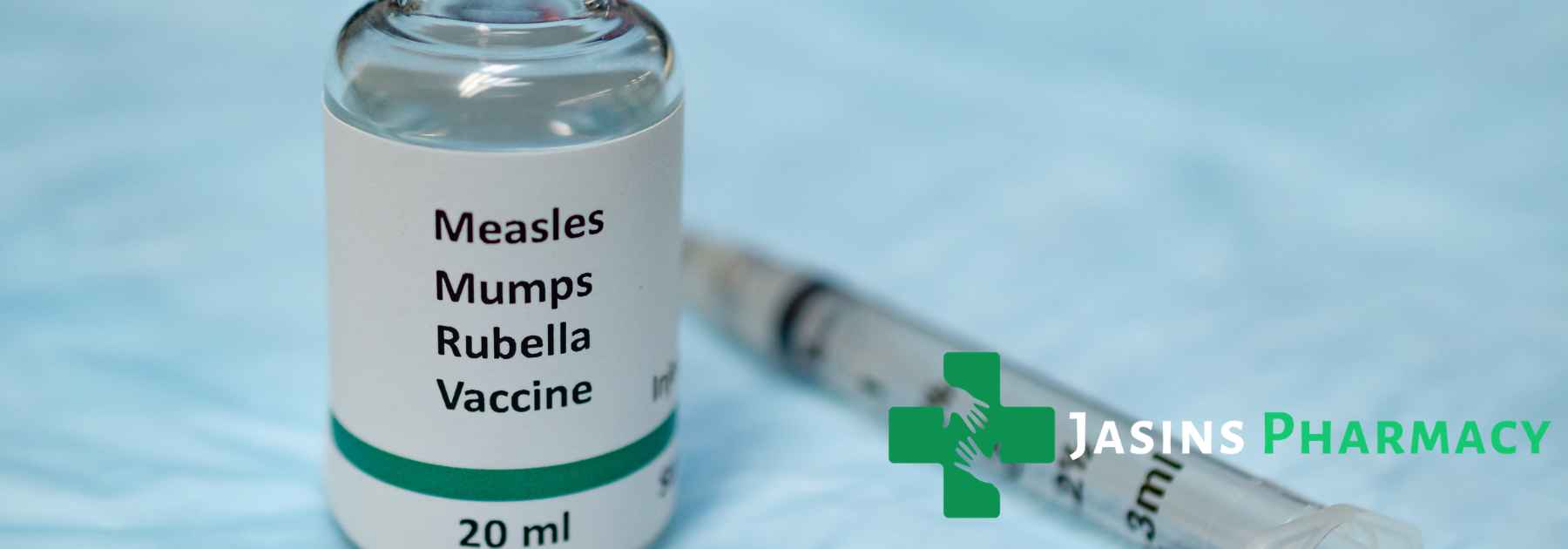
The MMR vaccine is a combined live attenuated vaccine that provides protection against all three viruses in a single injection. It has been in use for decades and has one of the strongest safety and efficacy profiles of any vaccine in the childhood immunisation schedule, with protection rates of over 97% for measles and rubella after two doses.
- First dose (NHS schedule) — given at twelve to thirteen months of age as part of the routine childhood immunisation programme; provides high levels of protection against all three viruses in the majority of recipients
- Second dose (NHS schedule) — given at three years and four months as part of the pre-school booster programme; a second dose achieves close to complete protection and is essential for full long-term immunity
- Catch-up doses for adults — anyone who has not received two documented doses of the MMR vaccine can receive catch-up doses at any age; two doses given at least one month apart are required for full protection if neither has been previously given
- Pre-travel vaccination — travellers without evidence of two prior MMR doses should be vaccinated before visiting countries with active outbreaks or lower vaccination coverage; a single dose can be given as immediate pre-travel protection if the full two-dose course cannot be completed before departure
- Suitability — the MMR vaccine is a live vaccine and is not suitable for pregnant women, severely immunocompromised individuals, or those with a history of anaphylaxis to neomycin or gelatin; our pharmacists will review your suitability during your pre-vaccination consultation
Because MMR is a live vaccine, a single dose provides long-lasting immunity in the majority of recipients. The second dose is given not as a booster in the traditional sense but to capture the small proportion of people who did not respond to the first dose — ensuring as close to complete population-level protection as possible.
Who Should Consider the MMR Vaccine?
Most adults born and educated in the UK will have received at least one dose of the MMR vaccine through the childhood immunisation programme. However, full two-dose protection is not universal, and there are several groups for whom vaccination or catch-up should be seriously considered.
The MMR vaccine is particularly advisable for:
- Travellers of any age who have not received two documented doses of the MMR vaccine and are visiting countries with active measles outbreaks or lower vaccination coverage
- Adults born between approximately 1970 and 1988, who may have received only one dose or no dose of the MMR vaccine, as the two-dose schedule was not fully established during this period in the UK
- Anyone who is uncertain about their vaccination history and cannot confirm that two doses have been received
- Healthcare workers, teachers, and others working in close contact settings where measles exposure risk is higher than average
- Women of childbearing age who have not been vaccinated against rubella, given the serious consequences of rubella infection in pregnancy
- Students starting university or college, who may be entering shared living and social settings that carry an elevated risk of mumps transmission in particular
A travel health consultation at Jasins Pharmacy in Hounslow can confirm your MMR status and, where doses are outstanding, arrange vaccination before your departure. Catch-up doses are available for adults of any age, and two doses can be given as little as one month apart if time before travel is limited.
Possible Side Effects
The MMR vaccine has an excellent safety record built over decades of use in hundreds of millions of people worldwide. The claim that the MMR vaccine is linked to autism has been thoroughly and repeatedly investigated and definitively disproven — the original study that suggested this link was retracted, and the researcher involved was struck off the medical register. Every major health authority in the world, including the NHS, WHO, and CDC, confirms that the MMR vaccine is safe.
Mild side effects following MMR vaccination may include:
- Soreness, redness, or mild swelling at the injection site
- A mild fever and general malaise in the days following vaccination
- A faint, non-infectious rash around seven to twelve days after the injection, reflecting a mild immune response to the measles component
- Temporary mild joint pain or stiffness, more common in adults and associated with the rubella component
- Mild swelling of the salivary glands, occasionally seen around three weeks after vaccination and associated with the mumps component
Serious adverse reactions to the MMR vaccine are very rare. Because it is a live vaccine, it is contraindicated in pregnancy and in those who are severely immunocompromised. If you have any concerns about suitability, are taking immunosuppressant medications, or have a history of significant allergic reactions, please raise these with our pharmacists during your consultation at Jasins Pharmacy in Hounslow so that suitability can be confirmed before the vaccine is administered.
Frequently Asked Questions
How do I know if I have had two doses of the MMR vaccine?
The most reliable way to confirm your MMR vaccination history is to check your personal health records or contact your GP surgery, who should hold a record of all childhood vaccinations. If records are unavailable or unclear, the safest approach is to receive the outstanding doses — two MMR doses can safely be given even if some or all have been previously administered, as there is no harm in receiving additional doses.
Can adults have the MMR vaccine?
The MMR vaccine is suitable for adults of any age who have not previously received two doses, and catch-up vaccination is recommended regardless of age. At Jasins Pharmacy in Hounslow, our pharmacists can administer catch-up MMR doses for adults without the need for a GP referral, making it straightforward to address any gaps in protection before travel.
Is the MMR vaccine available on the NHS?
The MMR vaccine is available on the NHS for children as part of the routine immunisation schedule, and catch-up doses are also available through GPs for those who have not completed the two-dose course. For travellers who need the vaccine arranged quickly before a trip, Jasins Pharmacy in Hounslow offers private MMR vaccination with same-week appointments available.
Can I have the MMR vaccine if I am pregnant?
The MMR vaccine is a live vaccine and is not recommended during pregnancy due to the theoretical risk of the live virus to the developing baby. Women who are not immune to rubella should be vaccinated before becoming pregnant, and any woman vaccinated with MMR is advised to avoid becoming pregnant for one month after receiving the vaccine.
How long does MMR protection last?
Two doses of the MMR vaccine are considered to provide long-lasting immunity against measles and rubella in the vast majority of recipients, and routine booster doses are not currently recommended for those who have completed the two-dose course. Protection against mumps after two doses is somewhat lower and can wane over time, which is why ensuring both doses have been given is particularly important.
Can I have the MMR vaccine at the same time as other travel vaccines?
The MMR vaccine can be given at the same time as most other travel vaccines, including inactivated vaccines such as hepatitis A, typhoid, and the combined Td/IPV. If two live vaccines need to be given and cannot be administered on the same day, they should be separated by at least four weeks — our pharmacists at Jasins Pharmacy will plan the most appropriate schedule during your consultation.
Protect Yourself Before You Travel
Measles, mumps, and rubella are preventable diseases, and ensuring your MMR vaccination is complete before travelling to affected regions is one of the most straightforward steps you can take to protect your health abroad. Book a travel health consultation at Jasins Pharmacy in Hounslow today and let our experienced team ensure you are fully protected before you go.